Your Phone Has a Bedtime
Somewhere within a mile of your house stands a cell tower, and at its base sits a cabinet of backup batteries. Those batteries are the real clock on your street's ability to talk to itself: most tower sites carry four to eight hours of reserve power, and when a long outage drains them, the tower goes dark and takes your bars with it.
Your phone doesn't die. That's the strange part. It sits there at 80 percent, a flashlight and a photo album, while every one of its actual jobs — calls, texts, maps, the group thread — quietly stops. Hurricane Maria took down 95 percent of Puerto Rico's cell sites in 2017. The 2021 Texas freeze left millions without service for days. The pattern is boring and reliable: any event that takes the grid down past a day or so takes the towers with it.
The fix is cheap, mildly nerdy, and takes about thirty minutes. Here it is.
What a Street Actually Needs to Say
Start with the messages, not the hardware. In a real outage, a street needs to say things like: we're fine. Do you have water? The oak came down on the Hendersons' service line — avoid the corner. Generator's running until noon if anyone needs to charge a phone.
Notice the range requirement: a few hundred yards. You are not hailing ships. The packaging that promises "35 miles" is describing two mountaintops with nothing in between; you are describing your block, through houses and trees, and your block is easy.
Two Radios, and an Honest Paragraph About Licenses
FRS — Family Radio Service — is the walkie-talkie from the sporting goods aisle. No license, roughly $25–60 a pair, and a realistic range of half a mile to two miles in a neighborhood. For one street, that is genuinely enough.
GMRS uses the same 22 channels at higher power — one to five miles realistically — and it does require a license. Radio people tend to mumble this part, so here it is plainly: the GMRS license costs $35, lasts ten years, has no exam, takes about ten minutes on the FCC website, and covers your whole immediate family. It is the cheapest piece of official paper in this entire field. Get it, stick the call sign on the fridge, and enjoy being the most legitimate operator on the block.
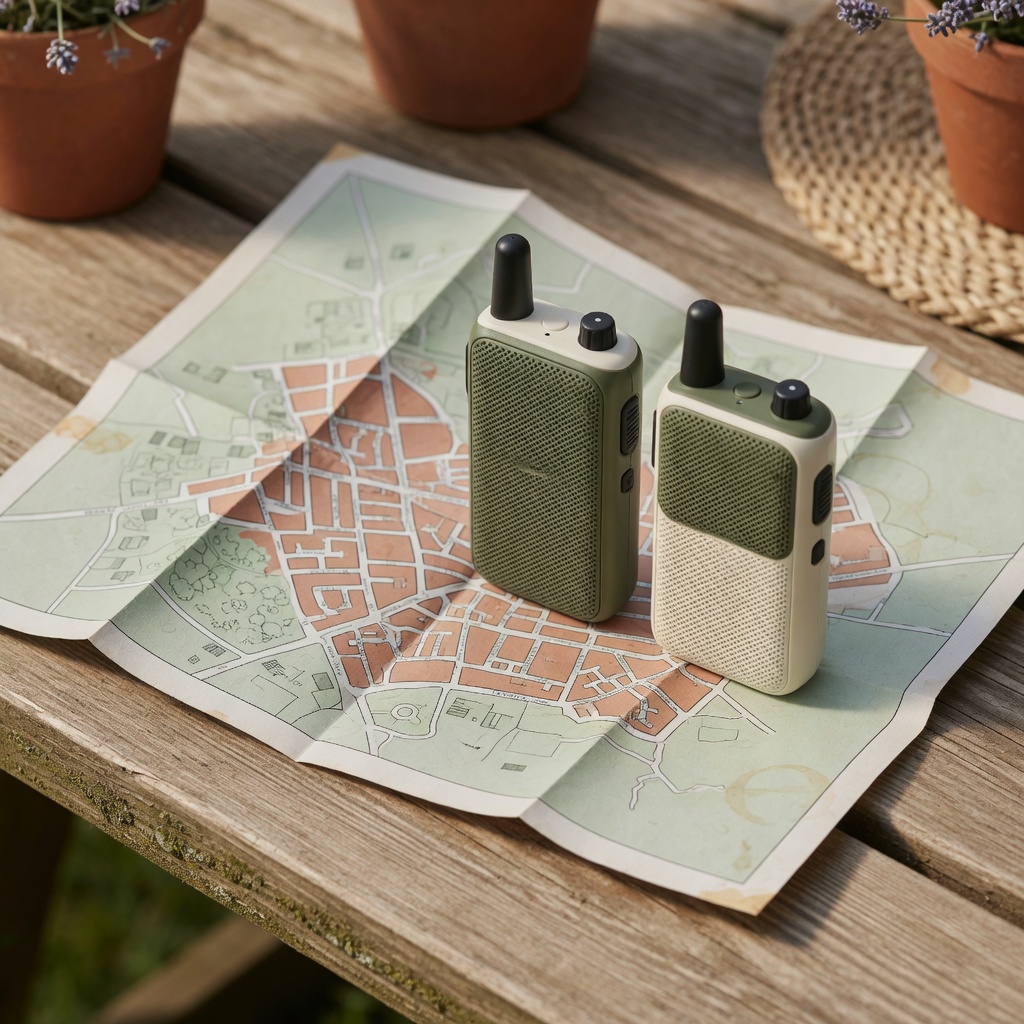
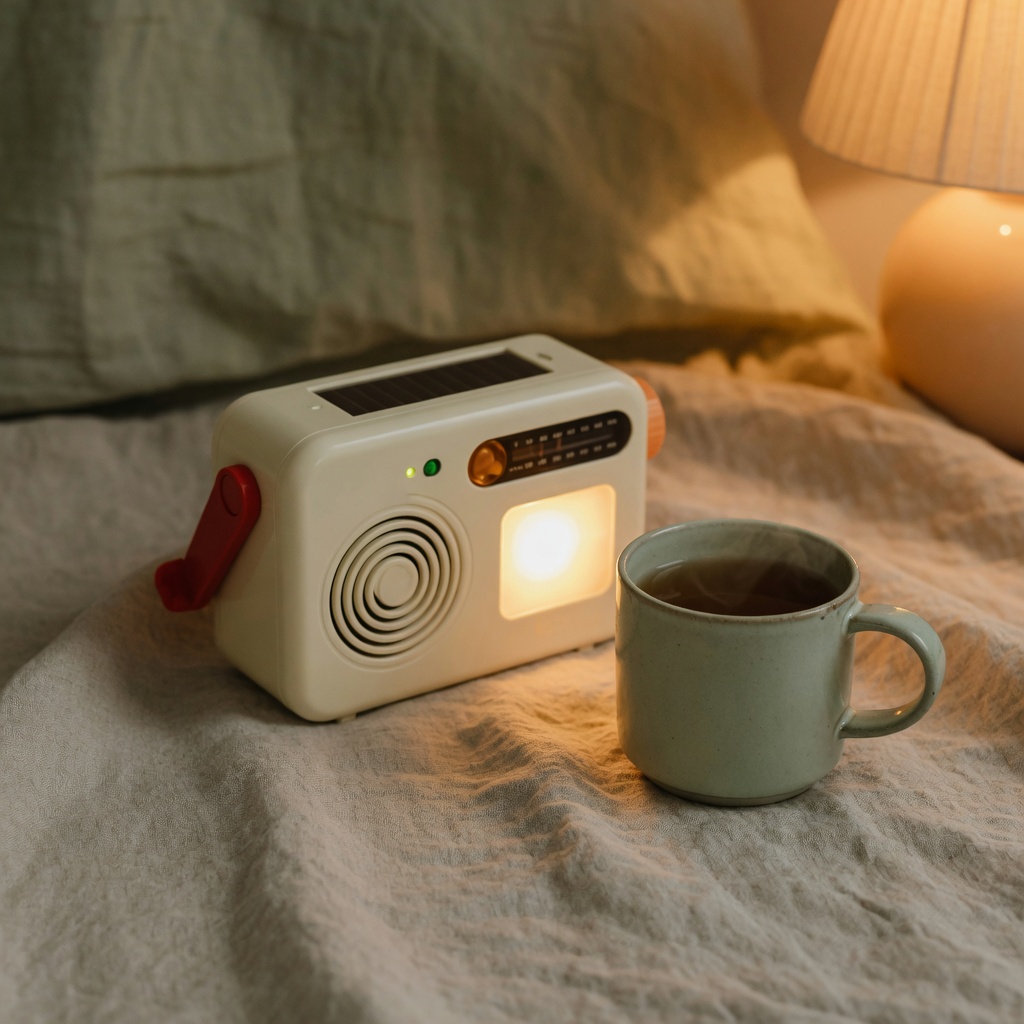
Matched hardware matters more than fancy hardware — a pre-paired set like the Neighborhood Mesh Walkie Set exists so that the radio in your kitchen and the radio three doors down are already speaking the same channel. And add one receive-only layer while you're at it: a hand-crank weather receiver — the Soft-Glow Emergency Radio spends its whole life pretending to be a lamp — pulls NOAA broadcasts down when everything else has gone quiet. Two-way is your street talking; one-way is the world telling your street what's coming.
The Thirty Minutes, Itemized
Minutes one through ten: order three to five handhelds. Minutes ten through twenty: apply for the GMRS license at fcc.gov. Minutes twenty through twenty-five: pick a home channel — 17 through 22 are GMRS-only, so there's less chatter from passing FRS traffic — and write it on an index card. Minutes twenty-five through thirty: walk that card to the households that should carry a radio.
Which households? Start with your three, then look for the people an outage leans on hardest: the family with a medical device that needs power, the retired couple at the end of the cul-de-sac, the natural organizer who already runs the block party. The card on each fridge reads, in its entirety: Channel 19. If the grid is down, check in at 9 and 6.
The Radio Check Is the Point
A radio in a drawer with dead batteries is a rumor of capability. What keeps radios alive is a ritual almost too small to schedule: the monthly check.
First Sunday, 9:00 a.m., ninety seconds. Everyone keys up in turn — name, status, one need or one offer. "Alvarez house, all good, the plum tree went feral, come take plums." Keep it short; the channel is shared and so is the morning. In ninety seconds you have tested batteries, confirmed coverage, and — this is the actual payload — heard your neighbors' voices in a context that isn't a complaint about parking.
Do it for three months and something shifts. The radio stops being emergency equipment and becomes a party line with excellent uptime. Which is exactly what you want, because gear that exists only for disasters gets forgotten, and gear that's part of the street's ordinary life stays charged.
Speaking of charged: batteries are the quiet failure mode. Rechargeables need a working outlet somewhere, so tape a set of spare alkalines to the back of each radio, and let whoever owns a solar panel be the street's official charging bench. It's a small job, and small jobs are how people find their place in a street's system.
One Antenna to Reach the World
Everything above covers your street. For anything farther — the county, the region, the question of when the water plant comes back — you want a ham radio operator, and here is the liberating part: you don't need to become one. You need to know one.
A single licensed amateur with a decent antenna can reach repeaters fifty miles out and relay for thirty households. Most neighborhoods already contain one, and they are usually delighted to be asked; check the local amateur radio club if yours is hiding. Then write their name down where you keep the rest of what you know about your street — the inventory exists precisely so this kind of fact doesn't live in one person's head.
This Week
Buy nothing yet, if you like. Just ask three neighbors one question: "If the towers went down, would you carry a radio if I handed you one?" You will not find a cheaper way to map your street's communication layer — and on the day an evacuation notice is moving up your street faster than official channels can carry it, channel 19 is how it will travel.
Thirty minutes. About $200. A street that can hear itself.
Reading is a way of having. This post is a knowledge offering — thinner evidence than a practiced kit, thicker than an unread tab.