The shrink-wrap problem
Somewhere in your house there is a first aid kit with the shrink-wrap still on. Maybe a water filter in its original box. Maybe a beautiful multi-tool that has, so far, opened exactly one thing: its own packaging.
We would know. We sell those. The Compact First Aid & Trauma Kit in our catalog is a genuinely good object — sensible contents, a real tourniquet, a layout you can navigate with shaking hands. And in Terrarium's own Readiness Score, that kit sitting sealed in your closet counts for less than the Saturday afternoon you spend learning to use it.
Read that again, because a store just said it: our product, unopened, is worth less than your practice. Stores don't usually talk like this. We think the ones that don't are selling you something other than capability.
Three shelves
Picture your household's capability as three shelves.
The bottom shelf is purchasable. Water containers. Stored calories. A lantern, a wool blanket, a radio. You can fill this shelf in one afternoon with a credit card, and some of it you genuinely should — a household that stores no water has a problem no amount of neighborliness solves by Tuesday. This shelf is real. It is also the only shelf anyone advertises, because it is the only shelf anyone can ship.
The middle shelf is practiced. Same objects, plus hours. The kit you have opened, used on an actual scraped knee, and repacked so you know where the gauze lives. The workbench where you have fixed the wobbly chair — our Home Repair Bench Starter Kit is a fine collection of tools, and it repairs exactly nothing until the second Saturday you spend at it. The distance between owning a thing and operating it while cold, stressed, and interrupted is the gap this essay is named for.
The top shelf is relational, and no truck delivers to it. The nurse two doors down who would come if you knocked at 2am. The neighbor who holds your spare key. The retired lineman who can look at your breaker panel and tell you what's actually wrong. This shelf cannot be bought at any price. It stocks slowly — in borrowed ladders, returned casserole dishes, and shoveled walks — and it is worth more than the other two combined.
How the score sees your closet
Here is where we show the arithmetic, because this is the honest-engine stream and that is the deal.
The Readiness Score is built from evidence, and evidence is graded. An object you have merely declared is thin evidence — it tells the engine what you bought, not what you can do. A skill you have actually demonstrated in your scenario answers is thicker. And the connection term — the who-are-your-three term — decays outright if you never re-affirm it, because a list of names from two years ago is a story, not a street.
The weights lean the same direction: connection and sharing together outweigh solo capability. Which means the cheapest points on the whole board are not in our catalog. They are on your street, and they cost an introduction.
We could have weighted it the other way. Somewhere, a commerce consultant is sighing. But a score you could max out with a credit card would be a lie with a progress bar, and we have retired our lies.
The arithmetic of two garages
Two neighbors, same block.
Neighbor A owns roughly $10,000 of equipment: a generator, pallets of freeze-dried food, an imposing shelf of hard cases. None of it has been used. A knows no one on the street by name.
Neighbor B owns maybe $1,000 of basics — water, pantry depth, that opened first aid kit — and has practiced with all of it. B also knows fifteen neighbors by name, including a nurse, an electrician, and a woman with a ham radio and firm opinions about antennas.
Now run the outage. A's generator won't start, and A meets the owner's manual for the first time by flashlight. Three doors down, B's street pools its refrigerators onto one working generator, the nurse walks over to check on the man with the oxygen concentrator, and the radio operator relays which roads are closed. B's evening is, honestly, kind of pleasant.
B is accessing tens of thousands of dollars of capability through relationships that cost nothing but time and a few loaves of banana bread. A owns more objects. B has more capability. The difference is everything that was never for sale.
Why a store would tell you this
Because the other model is worse — for you first, and eventually for us.
The fear-driven corner of this industry runs a loop you may recognize: feel anxious, buy something, feel briefly better, feel anxious again. The customer inside that loop buys more than ours does, for a while. They also end up with a garage of unopened boxes, no practiced skills, no neighbors, and a low-grade dread the purchases were supposed to fix. That is not a customer relationship. That is a casualty with a receipt.
The honest version sells less per panic and more per decade. A customer who opens the kit, practices with it, and knows her street buys the right things at the right times, for reasons she could explain to her grandmother. She trusts the store that told her the truth about what it couldn't sell her. She brings her neighbors. We will take that trade every day it's offered.
This week: cut the wrap
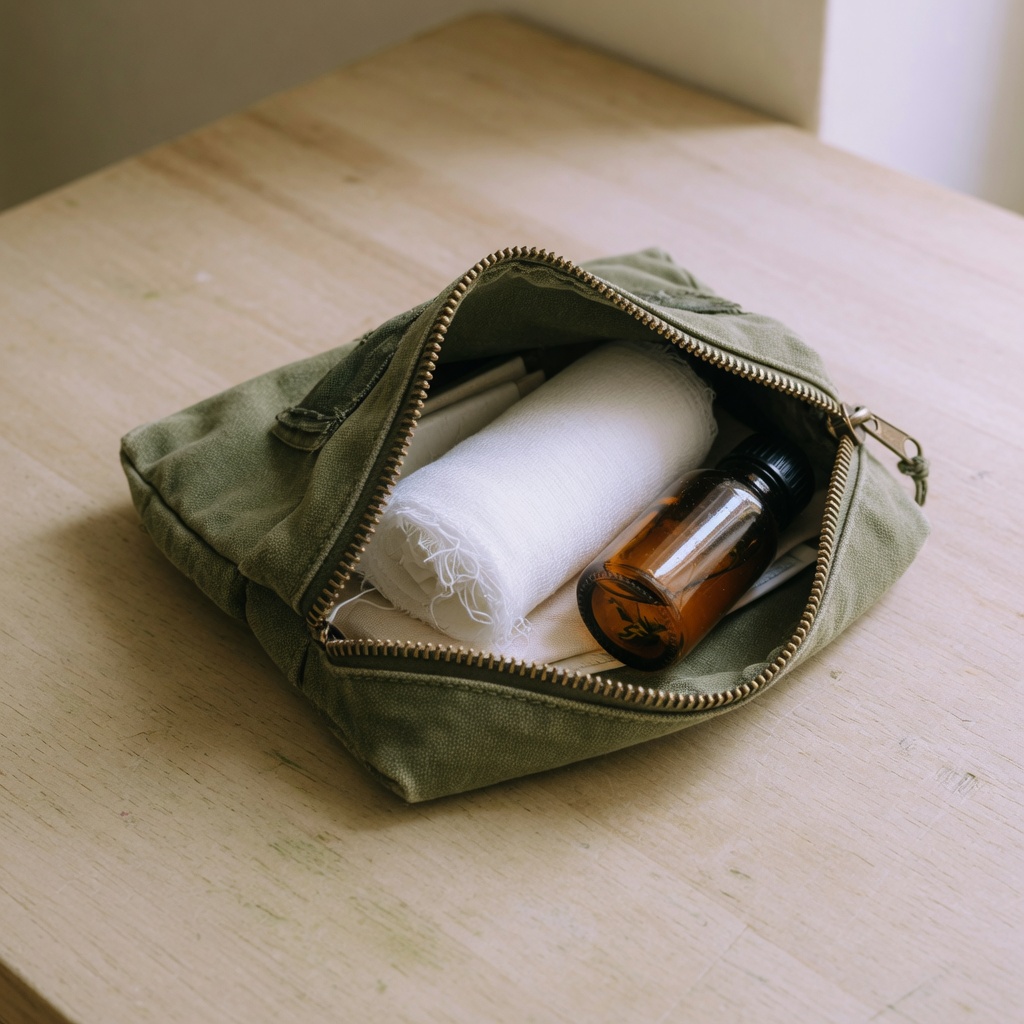
One small thing. Find the sealed kit — first aid, filter, whichever one you've been saving for someday — and open it. Lay it out on the kitchen table. Use one piece of it tonight, on purpose, while nothing is wrong. Twenty minutes. Your gear just moved up a shelf.
Then start on the shelf money can't reach: name your three — the neighbors you could call at 2am. If you can't name three yet, that isn't a failing grade. It's just the truthful one, and the fix is pleasanter than you'd think.
Reading is a way of having. This post is a knowledge offering — thinner evidence than a practiced kit, thicker than an unread tab.